This episode is sponsored by Alloy and Aqua Tru Shower.
- Alloy – Your sex life doesn’t have to change just because your hormones did. Visit https://myalloy.com and use code FLIPPING50 for $20 off your first order!
- AquaTru Shower – Unlock your hair & skin’s true potential with 20% Off AquaTru Shower using promo code SHFLIPPING50 at https://aquatrushower.com . It comes with a 30-day money back guarantee.
Menopause fitness researchers can help you separate the science from the endless stream of fitness advice aimed at women in midlife.
But here’s the catch: even highly respected researchers don’t always agree, and that doesn’t necessarily mean someone is wrong.
In this episode, you’ll meet several leading voices, learn where their research overlaps and differs, and get a better filter for deciding what deserves your attention. The goal isn’t to blindly follow an expert—it’s to become a smarter consumer of fitness information.
By the end, you’ll know exactly how to use menopause fitness researchers as a guide without letting another expert—or another viral post—do your thinking for you.
Why Knowing the Researcher Matters
- Scientific research provides a starting framework, not necessarily a one-size-fits-all prescription.
- There is an important distinction between researchers who conduct primary research and practitioners who translate research into real-world application.
- A good practitioner should be able to pivot the program based on the person, their goals, experience, and response.
Names of Menopause Fitness Researchers Every Midlife Woman Should Know
Dr. Stewart Phillips
- The Broad Muscle Biology Foundation
- The leading authority on:
- Muscle biology
- Muscle protein synthesis
- Protein
- Resistance training
- Muscle, aging, and longevity
- His approach emphasizes general principles that work for most people.
- A major strength of his approach is simplicity: science should make exercise and nutrition easier to act on, not so complicated that people are afraid to begin.
- His research provides the broad biological foundation for understanding how muscle responds to training and protein.
Dr. Stacy Sims
- Putting Women at the Center of the Research
- Approaches the same broad exercise and nutrition questions through a female-first lens.
- Her central premise is that hormonal transitions can change how women respond to exercise, fueling, recovery, and training.
- Her perspective is especially relevant to women navigating:
- Perimenopause
- Menopause
- Postmenopause
- Female-specific athletic performance
- Her background is strongly connected to active and competitive women, which can influence the lens through which she interprets research.
- Primary physiological research involves active laboratory testing:
- Thermoregulation and Hydration
- Metabolic Tracking
- Product Innovation
- Recommendations are designed for a competitive or highly active woman may not automatically translate to someone exercising primarily for health and longevity.
- Reproductive Health & Activity Obstacles (2026)
- Cultural & Physical Perceptions in Strength Sports (2026)
- Sex Differences in Athletic Injuries (2024)
- International Position Stand on Female Athletes (2023)
- Menopause & Caloric/Protein Research (Recent & Ongoing)
Discover Menopause Fitness Researchers Who Actually Deserve Your Attention
Where Dr. Stewart Phillips and Dr. Stacy Sims AGREE
- The Power of Resistance Training.
- Strength training is presented as essential for healthy aging.
- It supports metabolic health and helps fight age-related muscle loss, or sarcopenia.
- The Standard Protein RDA is not enough for active aging adults.
- The episode contrasts the 0.8 g/kg RDA with higher protein targets discussed by both researchers.
- The episode contrasts the 0.8 g/kg RDA with higher protein targets discussed by both researchers.
- Fighting Anabolic Resistance.
- The aging body requires a stronger and more deliberate stimulus to build or maintain the same amount of muscle.
- That stimulus can involve harder training, sufficient protein, or both.
Where Dr. Stewart Phillips and Dr. Stacy Sims DIFFER
Concept | Dr. Stewart Phillips | Dr. Stacy Sims |
The Sex-Difference Lens | Skeletal muscle remodeling and repair operate on highly similar biological pathways in both men and women. | “Women are not small men.” Believes a woman’s fluctuating hormones dictate entirely different fueling and recovery windows. |
Protein Thresholds | 1.2–1.6 g/kg/day for most people | 1.7–2.4 g/kg/day for active women, higher end during the perimenopause/ menopause transition |
Protein Timing & Windows | Total daily protein intake matters most. While timing has minor perks, he notes the “anabolic window” after a workout is wide and forgiving. | Precise timing is critical for women. Because women lack the same baseline testosterone levels as men, she argues they must consume high-quality protein (specifically rich in leucine) immediately post-workout to trigger muscle synthesis. |
How Heavy to Lift? | You can build muscle lifting lighter weights, provided you take the sets close to muscular failure. | Heavy, low-repetition lifting and plyometrics for women over 40. She asserts that without estrogen, women need the specific neurological and structural stress of heavy loads to preserve bone and power. |
Menopause Fitness Researchers to Follow for Muscle, Protein, and Metabolism
Bringing Dr. Lauren Colenso-Semple, Dr. Bill Campbell and Dr. Abby Smith-Ryan into the conversation expands the landscape of muscle and sports nutrition science. These five experts form a highly collaborative yet distinct scientific matrix.
Dr. Lauren Colenso-Semple
- The Evidence-Based Myth Buster
- Dr. Lauren presented a bridge between the broad muscle research of Dr. Stewart Phillips and the female-specific approach of Dr. Stacy Sims.
- Her work focuses on:
- Female endocrinology
- Strength training
- Menstrual cycle research
- Challenging exaggerated or unsupported claims
- One major difference is her more conservative interpretation of menstrual-cycle effects on training.
- Her research is presented as showing that hormonal fluctuations do not automatically require women to completely change their training across menstrual-cycle phases.
- She challenges the idea that every woman needs a special menopause workout or menopause-specific program.
- The episode’s practical distinction is important:
- Hormones matter.
- Basic training principles such as progressive overload still matter enormously.
- The discussion also highlights a communication lesson: aggressively labeling other people as “wrong” can alienate the very people who most need better information.
Dr. Bill Campbell
- Fat Loss Without Sacrificing Muscle
- Dr. Bill Campbell’s specialty brings body composition, fat loss, physique enhancement, and muscle retention into the conversation.
- His work emphasizes:
- Higher-protein diets
- Resistance training
- Preserving muscle during calorie restriction
- Body recomposition
- His research on diet breaks challenges the idea that dieting continuously is always the best strategy.
- Structured breaks from a calorie deficit may help support metabolic rate and lean muscle preservation.
The Menopause Fitness Researchers Behind Better Midlife Fitness Decisions
Dr. Abby Smith-Ryan
- Applied Research, Supplements and Body Composition
- Dr. Abby Smith-Ryan adds a highly practical, applied dimension to the group of researchers.
- Her research areas include:
- Sports supplementation
- Body composition
- Female metabolic health
- Creatine
- Caffeine
- Beta-alanine
- Her work is particularly relevant to women because it investigates how supplementation affects females across different ages.
- Her research on creatine, including potential benefits beyond muscle:
- Cellular energy
- Strength
- Recovery
- Female brain health
- Creatine is therefore presented as something that should not be dismissed as merely a supplement for male bodybuilders.
The Researchers Are More Complementary Than Contradictory
The researchers share major fundamentals—including resistance training, protein, and the importance of preserving muscle—but differ in how they interpret the evidence and which population they prioritize.
Researcher | Research Focus |
Dr. Stewart Phillips | Understanding muscle protein synthesis, muscle repair, and muscle biology. |
Dr. Stacy Sims | Female-specific physiology and athletic-performance applications. |
Dr. Lauren Colenso-Semple | Examining what the evidence actually supports about hormones and the menstrual cycle. |
Dr. Bill Campbell | Fat loss, body composition, muscle retention, and dieting strategies. |
Dr. Abby Smith-Ryan | Applied sports supplementation, body composition, and female metabolic health. |
Your Researcher Should Match Your Question
- Instead of asking, “Who is right?”, ask, “Who is the right researcher for this question?”
- Following multiple researchers can provide a more complete picture than relying on one authority.
Your Question | Researcher to Follow |
Want to understand how muscle builds and repairs? | Dr. Stewart Phillips |
Want strategies for getting lean while maintaining muscle? | Dr. Bill Campbell |
Want to understand whether the menstrual cycle should dictate training? | Dr. Lauren Colenso-Semple and |
Want a female-centered, athletic-performance framework? | Dr. Stacy Sims |
Why Menopause Fitness Researchers Don’t Always Agree on Women’s Training
Follow More Than One Researcher
- The recommendation is to follow all of these researchers, rather than choosing one person and dismissing everyone else.
- Disagreement can be useful because it reveals where:
- Evidence is strong
- Evidence is emerging
- Interpretation differs
- More research is needed
- If a researcher’s post makes you angry or uncomfortable, ask:
- Why am I reacting this way?
- Is this contradicting evidence I have accepted for years?
- Is the disagreement about the science or simply the way the message was delivered?
- A single social post does not need to overturn an established belief immediately.
- Stay curious, ask respectful questions, and dig into the underlying research.
- The ultimate goal is not to find the loudest expert. It is to become better at identifying useful, credible evidence and applying it appropriately to your own situation.
Menopause Fitness Researchers: How to Tell Good Science From Hype
If this episode made you flip your workout routine — share it!
👉 Post to your stories, tag @Flipping50TV in Instagram and share the episode to your best friend.
👉 Meet other women, who are done with outdated fitness advice, at Flipping50 Facebook Group.
👉 Subscribe, share, and leave a review if you’re ready to flip the script on Flipping 50 The Stronger Way.
Connect with Flipping 50:
- Flipping50 Insiders Facebook Group
- Instagram – @Flipping50TV
- YouTube – @Flipping50TV
- More Episodes – Flipping 50 The Stronger Way
Other Episodes You Might Like:
- Previous Episode – The Perimenopause Rules Nobody Told You About Resistance Training
- Next Episode – What Actually Changes for Strength Training After Menopause
- More Like This – The Bible for Exercise Guidelines Update: Here’s What It Means
Resources:
- Book an Ultimate Assessment with Debra! Get your HALO Method and Longevity Strategy at $497, instead of $997 rate. Together, you formulate the actual plan that will work for you!
- Get your lean, clean Flipping 50 Protein Powders to maintain muscle and support metabolism.
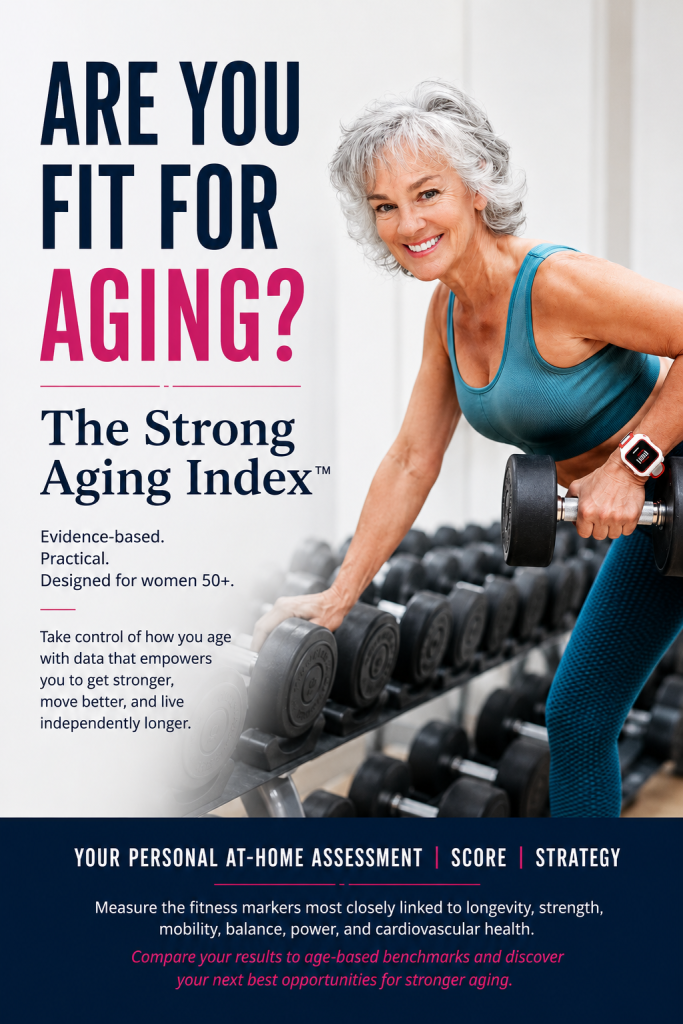
- Use Flipping 50 Strong Aging Index to measure what matters with an easy at-home self-assessment test you can do in minutes.