This episode is sponsored by Primeadine and BEAM Minerals.
- Primeadine by Oxford Healthspan supports your body to age well and feel yourself again through cellular renewal. Use the link or code FLIPPING20 for a 20% discount on your first order!
- BEAM Minerals – Get 20% off your first order at https://beamminerals.com/FLIPPING50 with code FLIPPING50.
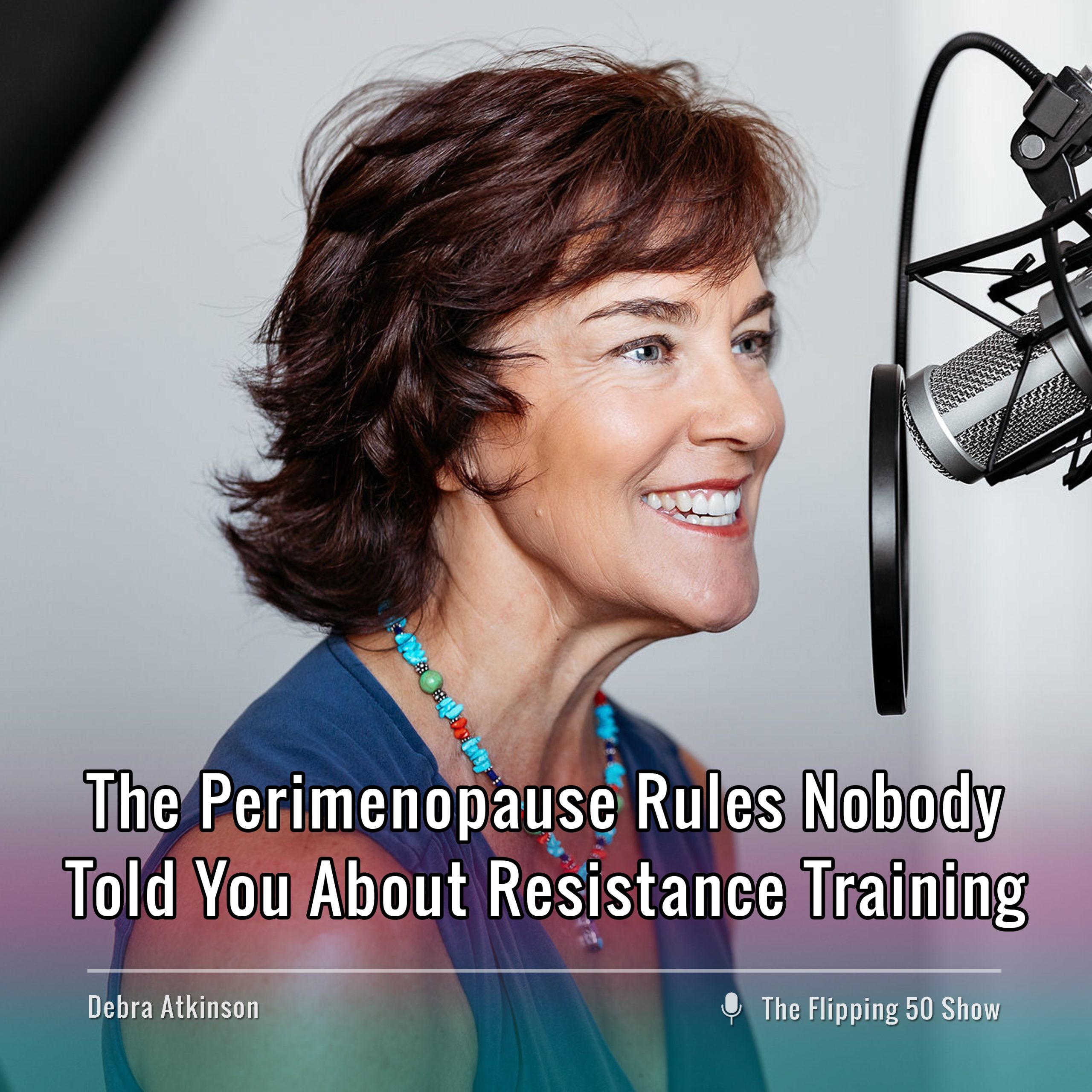
These are the perimenopause rules nobody told you—and they might be exactly what your workouts have been missing.
The key isn’t automatically doing more. It’s learning how to adjust training based on recovery, effort, experience, nutrition, and your changing physiology.
The episode outlines five perimenopause rules nobody told you and explains why flexibility may matter more than following a rigid workout formula.
Stop Assuming the Same Workout Should Always Work
- There is no single resistance-training formula that works for every woman during perimenopause.
- Age ranges and timelines are useful for context, but individual response matters more than the number on the calendar.
- Perimenopause should be viewed as a period when training needs to become more individualized rather than more extreme.
- Don’t change a workout just because you’re in perimenopause. Change it when your body is telling you the current approach is no longer working.
Perimenopause Rules Nobody Told You About Resistance Training and Recovery
The 5 Priorities in Perimenopause Rules Nobody Told You
1. Protect Your Recovery
- A warning sign is when a workout that used to leave you feeling energized now leaves you dragging before, during, or after training.
- Estrogen, progesterone, and testosterone change during this stage, while stress can become more impactful.
- Recovery includes more than rest days:
- Adequate sleep
- Enough calories
- Enough protein
- Micronutrient-dense foods
- Gut health and nutrient absorption
- Managing mental and emotional stress
- Time away from training to recharge
- Hard resistance-training sessions may require more than 48 hours of recovery, with 72 hours potentially being appropriate as you age.
- Key lesson: Recovery isn’t what happens after the workout. It’s part of the training plan.
2. Lift Hard
- Resistance training needs sufficient effort, but “lifting hard” does not automatically mean lifting the heaviest possible weight.
- Heavy is relative to the individual
- The goal is to reach muscular fatigue or get close to it, rather than simply accumulating repetitions.
- Key lesson: Quality and effort matter more than simply doing more repetitions or spending more time in the gym.
3. Heavy Lifting Still Matters
- “Lift hard” and “lift heavy” are related but not identical concepts.
- Heavy does not mean excessive.
- If someone can safely handle heavier loads, heavier lifting can provide a strong training stimulus with fewer repetitions.
- The appropriate load is determined by what the individual can safely tolerate and perform well.
- Key lesson: When appropriate and safe, heavier resistance can make training more efficient—not more exhausting.
Perimenopause Rules Nobody Told You About Muscle, Protein, and Recovery
4. Protein Becomes Non-Negotiable
- Protein supports more than muscle—it is needed by every cell in the body and contributes to muscle and bone health.
- As women age, anabolic resistance can make it harder for the body to use dietary protein for muscle protein synthesis.
- Protein quality matters, especially for people eating primarily plant-based diets, because some plant proteins provide lower amounts of certain essential amino acids.
- Protein should be distributed throughout the day, rather than concentrated into one meal.
- How much protein should you take?
- The larger goal isn’t simply losing weight—it is improving or maintaining body composition, particularly by protecting lean muscle while reducing excess body fat.
- Key lesson: During perimenopause, eating enough protein is part of the resistance-training program—not an optional nutrition add-on.
5. Flexibility Beats Perfection
- Modify the training plan based on how you’re recovering
- Hormonal fluctuations during perimenopause can make sleep disruption more common.
- Training should respond to the person rather than forcing the person to respond to the program.
- The important skill is learning to notice changes and giving yourself permission to adapt.
- Key lesson: The goal isn’t perfect consistency. It’s intelligent consistency—the ability to keep training while adjusting when your body needs something different.
Avoid Common Training Mistakes for Perimenopause, Rules Nobody Told You
The Biggest Perimenopause Training Mistakes
- Doing HIIT every day: A tool that can be valuable in small doses can become counterproductive when used excessively.
- Trying to burn off unexpected weight gain with more exercise: Increasing HIIT in response to weight changes may lead to exhaustion or injury rather than better results.
- Treating constant soreness as proof of an effective workout: Being perpetually sore isn’t necessarily a sign of productive training.
- Fasting too much: Restricting food can add another stressor when the body already has significant recovery demands.
- Failing to eat after resistance training: The episode recommends getting a protein-rich meal or snack after training, along with some carbohydrate.
- Trying to “outwork” hormones: Ignoring hormonal changes instead of adapting training to them can make the program less effective.
Perimenopause doesn’t mean resistance training stops working. It means the rules may need to become more individualized.
Train hard enough to make a difference, recover enough to benefit from it, fuel enough to support it, and stay flexible enough to adjust when your body changes.
Perimenopause Rules Nobody Told You About Training Without Overdoing It
If this episode made you flip your workout routine — share it!
👉 Post to your stories, tag @Flipping50TV in Instagram and share the episode to your best friend.
👉 Meet other women, who are done with outdated fitness advice, at Flipping50 Facebook Group.
👉 Subscribe, share, and leave a review if you’re ready to flip the script on Flipping 50 The Stronger Way.
Connect with Flipping 50:
- Flipping50 Insiders Facebook Group
- Instagram – @Flipping50TV
- YouTube – @Flipping50TV
- More Episodes – Flipping 50 The Stronger Way
Other Episodes You Might Like:
- Previous Episode – Building Muscle and Losing Fat in Menopause and Beyond
- Next Episode – Menopause Fitness Researchers: Who to Follow and Why
- More Like This:
- Resistance Training in Menopause Part 1 – Strength Training After 50: Where Do I Even Start?
- Resistance Training in Menopause Part 2 – You’re Already Lifting — So Why Isn’t It Working?
Resources:
- Book an Ultimate Assessment with Debra! Get your HALO Method and Longevity Strategy at $497, instead of $997 rate. Together, you formulate the actual plan that will work for you!
- Get your lean, clean Flipping 50 Protein Powders to maintain muscle and support metabolism.
- Use Flipping 50 Strong Aging Index to measure what matters with an easy at-home self-assessment test you can do in minutes.