This episode is sponsored by AirDoctor.
- AirDoctor – Head to https://AirDoctorPro.com and use promo code FLIPPING50 and get up to $300 off ANY of their select AirDoctor models, plus you will get a 3-year warranty, absolutely FREE! All AirDoctor air purifiers come with a 30-day money-back guarantee.
If you still want to target both building muscle and losing fat in menopause stay with me!
Know how to work with protein, calorie restriction, sleep, exercise, and hormone therapy. You’ll hear why eating more protein could help you get more from your training, why perpetual dieting may not be the answer, and why sleep deserves a much bigger seat at the table.
Be ready to stop fighting your body and start working with it, this conversation offers a fresh perspective on building muscle and losing fat in menopause.
My Guest:
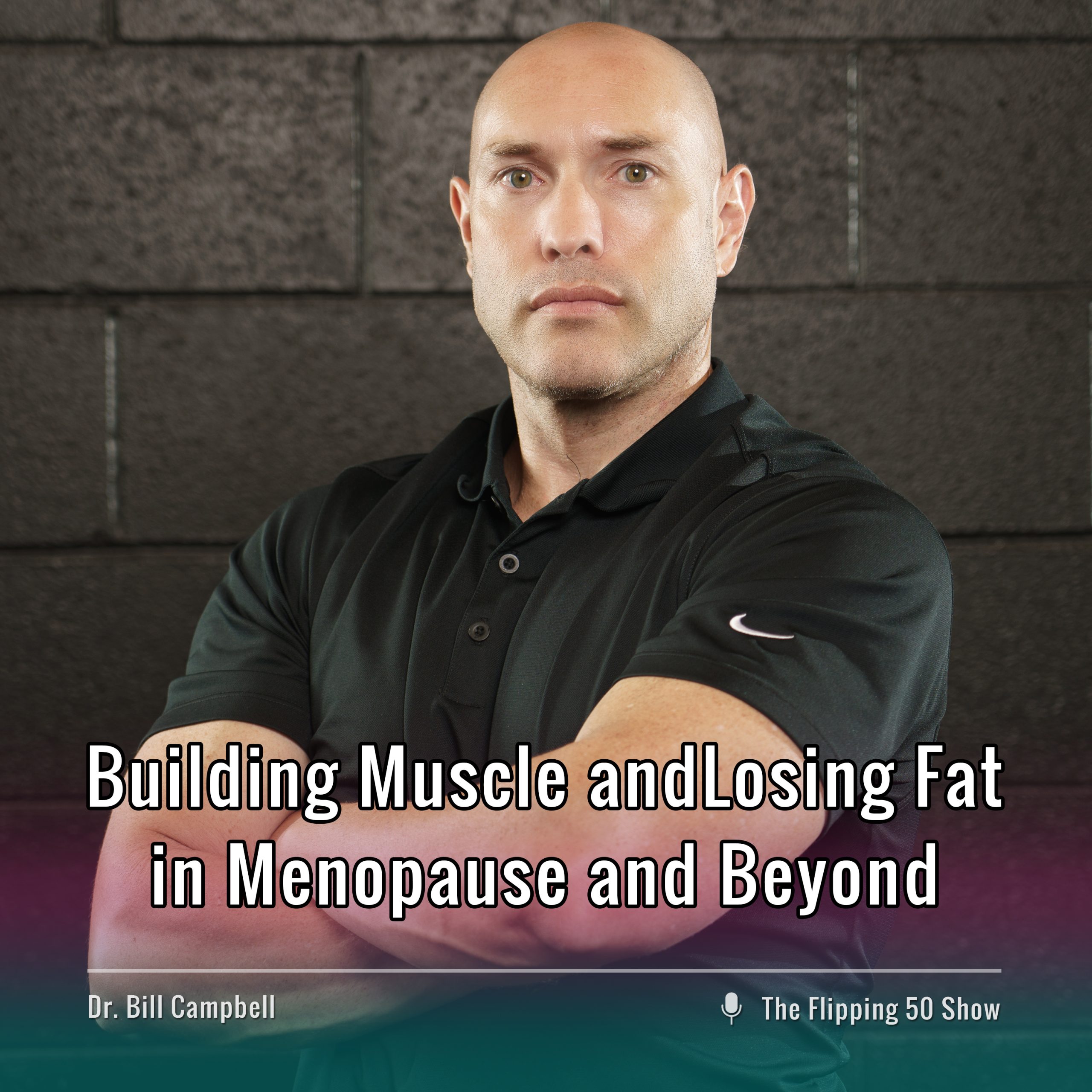
Dr. Bill Campbell is a Professor and Director of the Performance & Physique Enhancement Laboratory at the University of South Florida.
His research focuses on improving exercise performance and physique enhancement within a maintainable lifestyle. His pioneering research includes dietary protein intakes to optimize body composition, rapid fat loss strategies, and weight loss resistance in women going through the menopause transition. His research laboratory recently completed the largest menopause fitness survey ever conducted.
Building Muscle and Losing Fat in Menopause When Your Old Strategies Stop Working
Questions We Answer in This Episode:
- Why can weight loss become harder during menopause, even when you’re doing the same things that worked before?
- What does the research actually show about protein and body composition, especially muscle gain and fat loss?
- How much protein is enough, and is there a point where more protein stops providing additional muscle-building benefits?
- Could years of calorie restriction and perpetual dieting make fat loss harder in midlife?
- Can sleep affect the ability to build muscle and lose body fat during menopause?
- Does hormone therapy directly affect muscle and fat loss, or does it help in other ways?
- If you’re overwhelmed by all the menopause fitness advice, what three things should you focus on first?
Menopause Can Change the Body Composition Equation
- Menopause-related changes in body weight and composition are not universal. Some women experience very little difficulty, while others experience significant changes.
- Research and reports from women suggest that weight gain can occur relatively quickly during perimenopause through early postmenopause.
- The important shift is recognizing that “doing what you’ve always done” may not produce what it once did.
What “Weight Loss Resistance” Actually Means
- Weight loss resistance should not be interpreted as being completely unable to lose body fat.
- Dr. Bill’s working definition is getting less body-fat loss from the same calorie reduction that previously produced better results.
- One possible contributor is spending too long in an overly aggressive calorie deficit.
Building Muscle and Losing Fat in Menopause Without Extreme Dieting or Endless Cardio
Perpetual Dieting May Be Part of the Problem
- Years of intentionally maintaining very low body fat and repeatedly restricting calories could influence how the body responds later.
- Common patterns are:
- Months of dieting
- A short recovery period
- Another dieting phase
- Repeating the cycle over and over
- Long-term restriction is one factor worth considering when evaluating why a previously effective strategy may no longer work.
Food Quality Matters, But Protein Takes Center Stage
- The type and quality of nutrients can matter, not simply the number of calories consumed.
- Nutrient density may become more important with age because the body may not tolerate a suboptimal diet as well as it once did.
- A study compared diets with the same calories, protein, and carbohydrates but different types of dietary fat. The diet emphasizing monounsaturated fats—such as olive oil, avocados, and nuts—produced better fat-loss results than the diet emphasizing saturated fats.
Build the Diet Around Protein, Not a Carb-vs-Fat War
- Dr. Bill’s preferred framework is a protein-anchored diet.
- Once protein needs are covered, carbohydrates and fats can largely be adjusted according to personal preference.
- A very-low-carbohydrate diet may support fat loss for some people but is not presented as optimal for maximizing muscle mass when lifting weights.
- Don’t sacrifice muscle-building potential just to chase faster fat loss through extreme carbohydrate restriction.
How Much Protein Is Enough?
- Get enough protein first rather than assuming that dramatically more protein will automatically produce dramatically more muscle.
- Approximately 1.6 g/kg/day is the ceiling for significant additional muscle gain.
- Going above this amount is not necessarily useless, but the additional anabolic benefit becomes progressively smaller.
The Protein Strategy Behind Building Muscle and Losing Fat in Menopause
Protein and Body Recomposition: Muscle Up, Fat Down
- Body recomposition means gaining muscle while losing body fat at the same time.
- Dr. Bill defines “meaningful” recomposition in the research as gaining at least about 1 kg / 2.2 lb of lean mass while simultaneously losing at least 1 kg / 2.2 lb of body fat.
- Protein requires more energy to digest and process than carbohydrate or fat, and Campbell also discusses a potential nutrient-partitioning effect.
- If someone is already consuming around 0.75–1 g/lb of protein, dramatically increasing it further should not be expected to create massive additional changes.
- If someone is currently under-consuming protein, however, increasing it may produce noticeable body-composition changes relatively quickly.
Protein Has a Higher Thermic
- Protein requires considerably more energy to digest, absorb, transport, and process than carbohydrates or fats.
- Campbell gives the approximate thermic effect as:
- Fat: about 3%
- Carbohydrate: ~7%
- Protein: ~25%
- This means the body uses more energy processing protein than it does processing the same number of calories from fat or carbohydrate.
- Overeating on protein is likely less damaging to body composition than overeating on other foods.
The Smarter Approach to Building Muscle and Losing Fat in Menopause
Stop Treating Fat Loss as a Permanent Diet
- One of the biggest communication gaps is the difference between using a diet to lose excess body fat and living permanently in a dieting state.
- Dr. Bill argues for a different long-term model: a high-energy-flux lifestyle.
- High energy flux means:
- More daily movement and activity.
- Appropriate food intake to support that activity.
- Adequate protein.
- Sufficient carbohydrates and other nutrients.
- This is different from exercising intensely for 30 minutes while spending the rest of the day sedentary.
- Dr. Bill describes his own shift toward:
- Less lifting volume.
- More conditioning.
- More walking.
- A generally more active lifestyle.
- The goal is to match higher activity with adequate food, rather than constantly trying to compensate for a sedentary lifestyle by eating less.
- Once the goal is reached, the strategy can shift toward gradually increasing calories and building a more active lifestyle that supports maintenance.
Hormone Therapy May Indirectly Support Fitness and Recovery
- Resistance training remains the foundation for building muscle.
- The potential value of hormone therapy may be less about making resistance training magically effective and more about helping women sleep, feel better, reduce symptoms, and actually participate consistently in their fitness lifestyle.
- Its potential importance in this conversation is quality of life.
Sleep Can Affect Fat-Loss Results
- Sleep is not a minor recovery detail when the goal is improving body composition.
- Poor sleep combined with more exercise and more restriction may potentially make the situation worse rather than better.
What Women Get Wrong About Building Muscle and Losing Fat in Menopause
When More Exercise May Be the Wrong Answer
- For women who are exhausted, stressed, sleeping poorly, and pushing through increasingly intense workouts, he discusses an anecdotal “reset” approach.
- The approach involves:
- Temporarily stepping back from intense fitness training.
- Continuing gentle movement such as outdoor walking.
- Eating a Mediterranean-style diet rich in fruits and vegetables.
- Allowing the body a period of reduced training stress.
- Recognize when adding more exercise and restriction is no longer productive and consider whether recovery needs to come first.
Three Priorities for Women in Midlife
- Don’t Abandon Your Fitness Lifestyle
- Educate Yourself About Hormone Therapy
- Optimize Protein
Connect with Dr. Bill:
- Website – Dr. Bill Campbell PhD
- Instagram: @billcampbellphd
- YouTube: @BillCampbellPHD
Other Episodes You Might Like:
- Previous Episode – You’re Already Lifting — So Why Isn’t It Working?
- Next Episode – The Perimenopause Rules Nobody Told You About Resistance Training
- More Like This:
Resources:
- Not sure you’re doing what is best for you right now? Get a 90-Minute Ultimate Consultation with Debra. Together, you formulate the actual plan that will work for you! Currently 1/2 off for podcast listeners.
- Use Flipping 50 Active Aging Index to measure what matters with an easy at-home self-assessment test you can do in minutes.