This episode is sponsored by Alloy.
- Alloy – Try the original M4 skincare from Alloy. Visit https://myalloy.com and use code FLIPPING50 for 20% off your first order!
Feeling exhausted but can’t shut your brain off after 50?
In this episode, we dig into what may be happening in your brain and nervous system as hormones shift through midlife and why stress can start feeling very different.
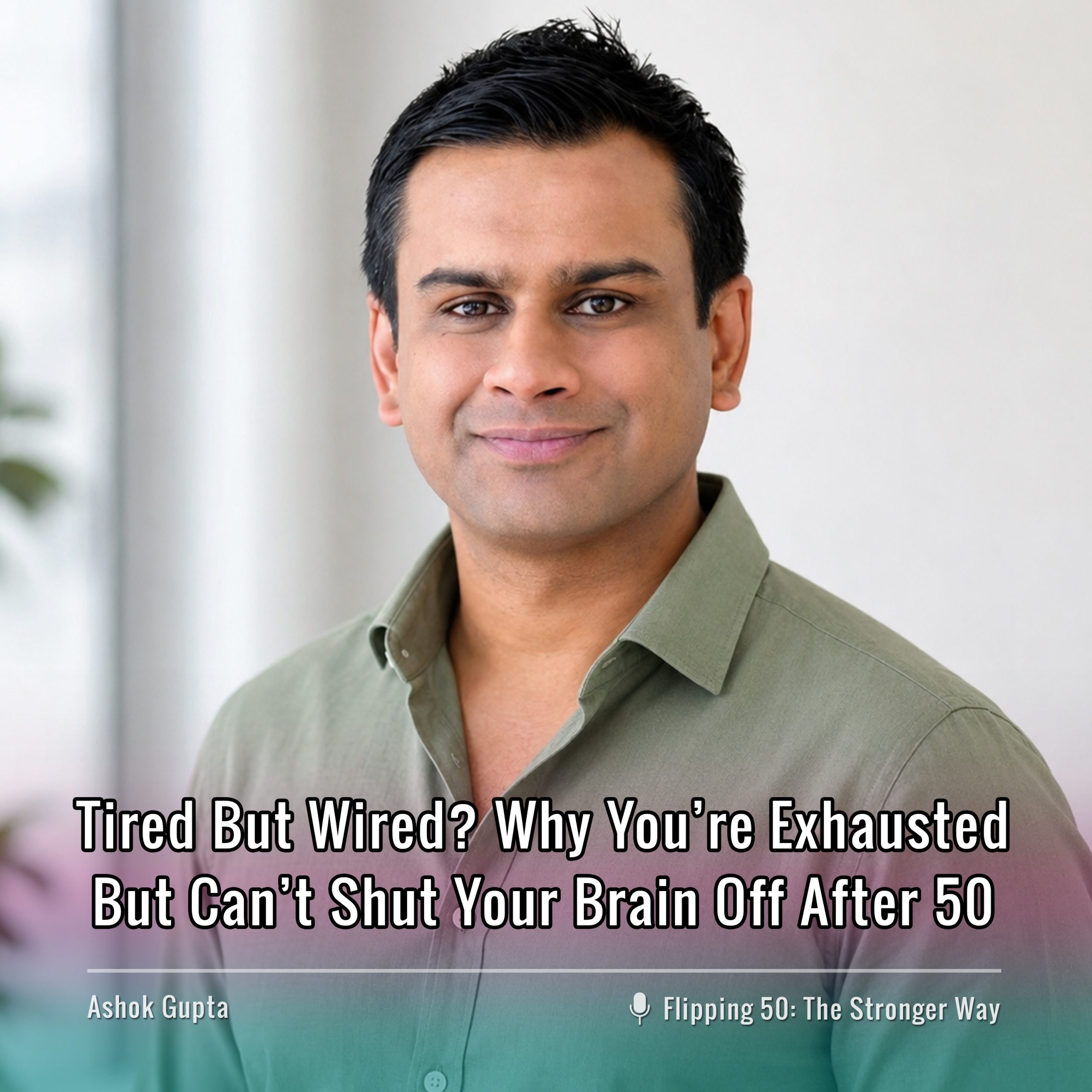
Ashok Gupta explains brain retraining, predictive processing, and why calming your nervous system may be only part of the answer.
If you’re tired of being tired but still feeling like your brain is always “on,” this conversation gives you a whole new way to understand why you can’t shut your brain off after 50.
My Guest:
Ashok Gupta is an internationally recognized speaker and founder of the Gupta Program, a clinically researched brain retraining programme inspired by his own recovery from chronic fatigue syndrome. Today, he joins us to explore the brain–body connection—and what it could mean for women experiencing fatigue, brain fog or feeling “tired but wired” in midlife.
Questions We Answer in This Episode:
- [00:04:42] How can chronic fatigue and brain retraining be connected?
- [00:07:11] What’s happening when you’re “wired but tired”?
- [00:07:30] How might hormonal changes in menopause affect the brain’s response to stress and threat?
- [00:12:15] Why might the brain predict threats instead of simply reacting to them?
- [00:13:49] How is brain retraining different from meditation, positive thinking, or affirmations?
- [00:18:32] What does the research show, and where does brain retraining fit alongside medical care?
- [00:20:30] Why might midlife be an opportunity for greater self-awareness?
What Your Nervous System Is Telling You When You Can’t Shut Your Brain Off After 50
Chronic Fatigue Can Feel Like Hitting a Wall
- Ashok’s experience with chronic fatigue began after what he describes as a viral illness while studying at Cambridge.
- Instead of recovering normally, his fatigue and exhaustion progressively worsened.
- Symptoms included:
- Difficulty thinking
- Physical symptoms
- Muscle tightness
- Severe exhaustion
- Eventually being almost bed-bound or house-bound
Why “Tired but Wired” Can Become a Vicious Cycle
- “Wired but tired” describes the frustrating experience of being physically exhausted while the brain refuses to switch off.
- You can spend the day wanting to go to bed, only to find that your brain remains active once you’re there.
Menopause Changes the Brain’s Hormonal Environment
- Hormones have neuroprotective effects.
- Hormones are not the entire explanation for fatigue or brain fog, but changing hormone levels can influence how the brain responds to stress.
- Reduced hormonal neuroprotection may make certain brain systems more reactive.
Your Brain May Be Predicting Threat—Not Just Reacting to It
- “Predictive Processing” is when the brain doesn’t simply react to what’s happening in the moment; it uses previous experiences to help predict what might happen next.
- A physical sensation or symptom can potentially be interpreted by the brain as a sign of something more serious.
- Emotional situations and environmental stressors can also become part of this threat-prediction process.
- With less hormonal neuroprotection, Ashok proposes that the brain may become more likely to magnify perceived threats.
- This can activate the sympathetic nervous system, increasing energy demands and potentially contributing to fatigue.
The Midlife Brain and Stress Connection When You Can’t Shut Your Brain Off After 50
Brain Retraining
- Meditation, breathing exercises, mindfulness, and other nervous-system regulation practices can help reduce overall brain stimulation.
- Know how to calm the brain and how to understand why the brain is reacting.
- The first step is reducing stimulation and creating enough calm to observe what is happening.
- The next step is developing insight into the patterns that trigger the brain’s response.
- Brain retraining involves looking at the underlying anticipatory patterns rather than simply trying to relax.
The “Sunday Evening Wobble”
- Ashok uses the example of anxiety beginning Sunday evening because Monday and work are approaching.
- The stressful event hasn’t happened yet, but the brain begins anticipating it.
- The anticipation itself can interfere with the present moment.
- His suggested approach:
- Calm the brain.
- Identify the anticipated threat.
- Look for places where the brain may be magnifying danger.
- Develop greater awareness of the pattern.
- These threat responses may contribute to fatigue and brain fog.
Younger Generations Are Experiencing a Different Kind of Threat Load
- Younger generations are also experiencing heightened anxiety, with different factors than older generations:
- Constant comparison through social media
- Heavy screen use
- Financial uncertainty
- Concerns surrounding AI and employment
- Less opportunity to develop resilience through unstructured experiences and adversity
- Reduced exposure to certain forms of independence and risk may affect how people learn to handle adversity
Medical Evaluation Comes First
- Fatigue, exhaustion, and brain fog can also occur with more serious medical conditions.
- Get symptoms medically evaluated first.
- Brain retraining is presented as something that can complement—not replace—medical care.
- Once serious underlying conditions have been evaluated, the approach discussed combines:
- Lifestyle
- Exercise
- Sleep
- Nutrition
- Nervous-system regulation
- Brain retraining
Why You Can’t Shut Your Brain Off After 50 and Feel Exhausted
What the Program’s Research Has Found
- The clinical work includes women in their 40s, 50s, and 60s experiencing fatigue, burnout, anxiety, long COVID, fibromyalgia, and chronic fatigue.
- He also reports a study involving older women that found:
- Improvements in anxiety and depression
- Improvement in general symptoms
- A 16% improvement in cognitive ability/function
- He describes the findings as evidence supporting a neuroprotective effect from brain retraining.
Midlife Can Be an Opportunity for Greater Self-Awareness
- The reduction in reproductive-hormone neuroprotection connects with the importance of developing greater self-awareness as women age.
- Women in their 50s and 60s are associated with turning inward, reflection, deeper self-awareness, and understanding personal patterns.
- Symptoms such as brain fog, fatigue, and sleep difficulties can potentially become a doorway to examining what the nervous system is responding to.
The Gupta Program
- His program offers a 28-day free trial incorporating 10–20 minutes per day of meditation, breathing exercises, and brain-retraining techniques.
- People with significant unresolved trauma may experience increased anxiety when beginning practices such as breathing or meditation.
- The program’s progression:
- Nervous-system regulation
- Calming the brain
- Brain retraining
- Working with adaptive or defensive responses
- The broader goal is to develop a better understanding of the patterns behind the body’s and brain’s responses.
Connect with Ashok:
- Website – Gupta Program use code DEBRA10 for 10% discount
- App – Gupta Program available in iOS and Android
- Facebook – Gupta Program
- Instagram – @guptaprogram
- YouTube – Gupta Program
- Tiktok – @guptaprogram
Can’t Shut Your Brain Off After 50: What Changes During Menopause
Connect with Flipping 50:
- Facebook Group – Flipping50 Insiders
- Instagram – @Flipping50TV
- YouTube – @Flipping50TV
- More Episodes – Flipping 50 The Stronger Way
Other Episodes You Might Like:
- Previous Episode – 3 Keys for Menopause Fat Loss from a Fat Loss Researcher
- Next Episode – Is There Really a Best Time to Strength Train After 50?
- More Like This – The Link Between Creatine, Brain Health & Longevity
Resources:
- Not sure you’re doing what is best for you right now? Get a 90-Minute Ultimate Consultation with Debra. Together, you formulate the actual plan that will work for you!
- Use Flipping 50 Strong Aging Index to measure what matters with an easy at-home self-assessment test you can do in minutes.
- Try the Gupta Program and use code DEBRA10 for 10% discount.