
When you’re setting New Year’s resolutions or considering gingerly easing yourself off the couch, its not typically bone density that motivates you. In 32 years as a fitness professional and in addition to the sessions I’ve personally conducted, supervised 200,000 personal training sessions over a six year period of time, exactly twice have I had a call from someone whose sole reason for contacting me was to improve bone density. Prior to each of those phone calls, both women had had a conversation with their doctor.
“Deb, I have osteoporosis.”
Their major risk factors?
They both had small frames and low weight. Though both had a long history of regular physical activity, neither had a history of weight training. In other cases, among women of various weights and frames, upon discovery of osteopenia or osteoporosis when supplementation and exercise were recommended, again, weight training had never been a part of the exercise routine.
If you’re looking for cliff note version of this blog, it is this: begin lifting weights.
If you’re currently lifting, don’t stop.
Beyond that, make sure your exercise routine matches your goal. Pink 2-pound dumbbells and your own body weight are not enough to increase bone density.
You may prefer it. You may find it more convenient. However, light weight done many times does not have the same effect on bones as does heavy weight done with fewer repetitions. You may need access to machine weights and/or to heavier options than you can safely perform at home.
Yes, you may start at home. You may start with light weights, and in fact, I recommend it. Get instruction on good technique. Posture is a main concern and primary focus for preventing and treating osteoporosis and the risk of fracture. I’ll dive into the rest of the facts. It’s often confusing, and information can be conflicting. As a Medical Exercise Specialist having lectured since 1996 about osteoporosis prevention and protocols I share here the most common misconceptions among women, trainers, and even doctors.
You may not have time right now. You may prefer other forms of exercise more. The fact is, however, no exercise mode will help you reduce bone losses more (if you’re over 50) as resistance training will. No exercise left out of your routine will increase your risk for osteoporosis and fractures more than weight training.
Based on several factors, among them bone density, weight training should move to your A list of priorities if you’re 50 or older.
Since your bone mass peaked somewhere between 30 and 35, you’ve been losing 1-3% of your bone mass annually if you keep up with the average. During menopause which lasts 3-5 years for some women, bone losses accelerate to 3-5% of total bone mass a year. Eventually, losses return to an average of about 1% for most women but can be higher depending on several lifestyle factors for the rest of your life.
If you’re doing math, and you plan to live to 100, the problem becomes obvious. It all hinges on how much bone density you had in the bank in the first place. Up to the point you peaked at bone density your bone remodeled faster than it broke down. At midlife the breakdown occurs at a faster rate. So, it’s time to look at how exercise can help decrease your risk of osteoporosis, the diagnosis of a bone density statistically below ideal. Osteopenia is simply that no-woman’s land between ideal and 2.5 standard deviations below the ideal. It’s still not good.
Risk Factors for Osteoporosis include:
Uncontrollable risk factors:
- Activity history
- Age
- Gender
- Post-menopausal status
- Corticosteroid use
- Genetics (yes, you can blame your mother for this one)
- Small, thin frame
Controllable risk factors:
- Physical activity
- Diet (including specifically Calcium and Vitamin D)
- Caffeine
- Alcohol
- Smoking
This list is not all-inclusive.
The best time to build bone density is in childhood and adolescence. Higher impact activities will impose stress on the bones, and in return the bone responds by getting stronger. Jumping and gymnastics lend themselves to greater bone density that do swimming and bicycling. This is true both for children and adults. Of course, the risk of certain high impact activities for adults has to be measured against the benefit.
There are different levels of recommended activity based on your current status. Ironically, what builds bone density and prevents osteoporosis, may be a risk factor for fracture once you have osteoporosis.
Continuum of Exercise for Bone Density
- Swimming – no effect and potentially unloading may actually decrease bone density
- Biking – no effect and potentially unloading may decrease bone density
- Walking – minimal stress (repetitive actions using body weight have minimum return)
- Running – history of running provides stronger leg bones, yet both running and walking have limited positive effects
- Plyometric exercise (Jumping)
- Weight training (with adequate load)
In this continuum to visually provide you a better picture, imagine a big gap between running and plyometric exercise. The difference is that great. “Adequate load” indicated next to weight training means that if you’ve never lifted weights before light weights will reap some rewards as you increase progressively in the first six months. Beyond six months, however, you may not experience more benefit unless you increase your load or add speed (power) to the movement. Ten or fewer repetitions correlates with 80% of a 1-repetition maximum, or the equivalent, and has been associated with the most bone benefits.
Keeping Your Eye On The Bone
Increases in bone density are relatively small for post-menopausal women but the losses attenuated make risk of fracture significantly lower. That is, you are not going to experience much increase in bone density after you’ve reached the peak at age 35. You can, however, slow the eminent losses. I mentioned above average losses of 1-3% a year, accelerated to 3-5% during menopause, resuming 1-3% loss a year after menopause. If you’re lifting weights and gain a single percent offsetting loss the net change of 4% at best would be significant.
Levels of Exercise for Osteoporosis
No diagnosis: current exercise guidelines are appropriate – 2x a week weight training, cardiovascular moderate exercise 30 minutes most days or vigorous exercise total of 75 mins a week, with vigorous providing more benefit
Diagnosis: moderate preferred over vigorous, individual assessment for movement
For All:
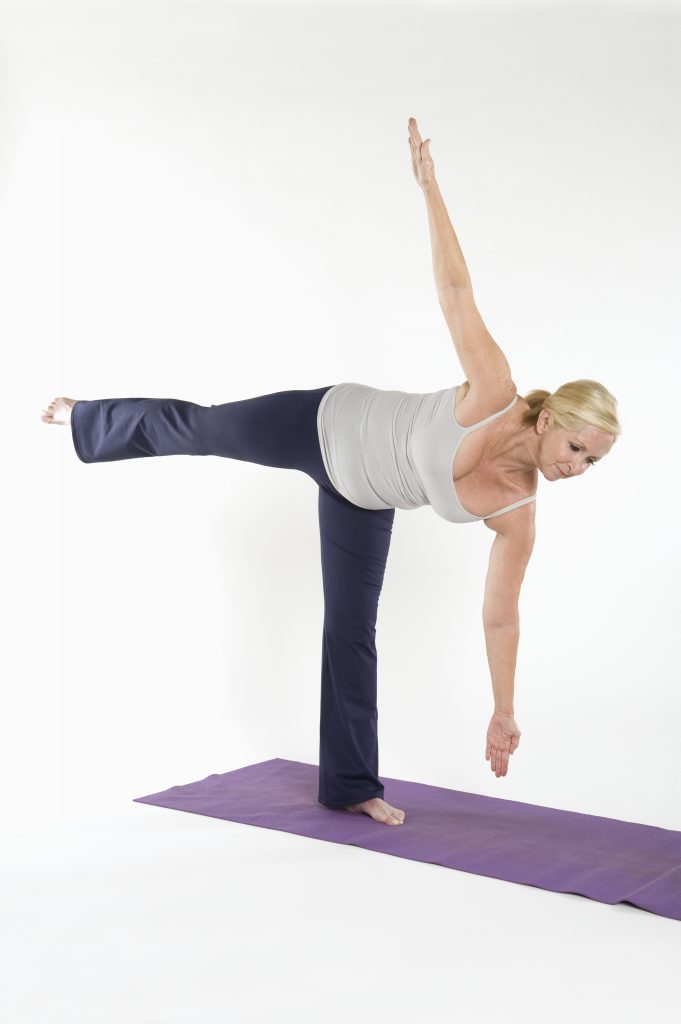
Daily: back extension strengtheners, balance, and endurance (holds of pressing shoulders to the ground – head supported by a pillow only if it doesn’t touch the surface
Spine-sparing techniques: hip hinge, rise from the floor, core strength, avoid rotation of rapid or repetitive forward flexion with load
When You Have Osteoporosis
- Fall prevention – spend 15-20 minutes a day on balance activities
- Safe movement – understand how to lift, get in and out of cars, the bed and perform daily activities
- Slow the rate of bone loss (maintain rather than gain, see above)
- Pain control in those with multiple fractures
- Avoid: twisting and bending particularly with load, end-point range of motion, lifting heavy objects above the head, lifting maximum loads
- Form becomes much more important than intensity
Individuals vary on what they can do based on their history of activity and experience as well as severity of bone loss. One of the clients I mentioned in the opening paragraphs loved downhill skiing and was about to retire in Colorado spending a great deal of time doing it. Fear suddenly hit her. With her doctor’s blessing however, she continued. The risk of potentially not living life to it’s fullest also had to be considered.
Experts in general all agree that movement is better than not moving and that there shouldn’t be a “generic” weight or activity restriction placed on all people diagnosed with osteoporosis. You may receive a “don’t lift more than 10 pound” limit recommendation. Be sure to ask for details about why and share your personal activity history to be sure that’s a fit for you.
History of Spinal Fractures?
If you have experienced one or more fractures, you want even more specific advice. Get an individual assessment of balance, mobility, past activities, and how your daily activities of life should be done to modify movement so you can reduce risk of further fracture.
Seek:
- a Medical Exercise Specialist or Clinical Exercise Specialist (look for ACE or ACSM certifications)
- with experience working with osteoporosis diagnosis (you don’t want someone cutting their teeth on your case)
I’d love to hear from you. Post your questions and comments.
Is osteoporosis a concern for you? Have you had a bone scan?
Next Blog: Watch Thursday for the second part of this blog about the nutrition side of the story.
Resources:
Guadalupe-Grau A1, Fuentes T, Guerra B, Calbet JA. Exercise and bone mass in adults. Sports Med. 2009;39(6):439-68. doi: 10.2165/00007256-200939060-00002.
Giangregorio LM, McGill S, Wark JD, et al. Too Fit To Fracture: outcomes of a Delphi consensus process on physical activity and exercise recommendations for adults with osteoporosis with or without vertebral fractures. Osteoporosis international : a journal established as result of cooperation between the European Foundation for Osteoporosis and the National Osteoporosis Foundation of the USA. 2015;26(3):891-910. doi:10.1007/s00198-014-2881-4.