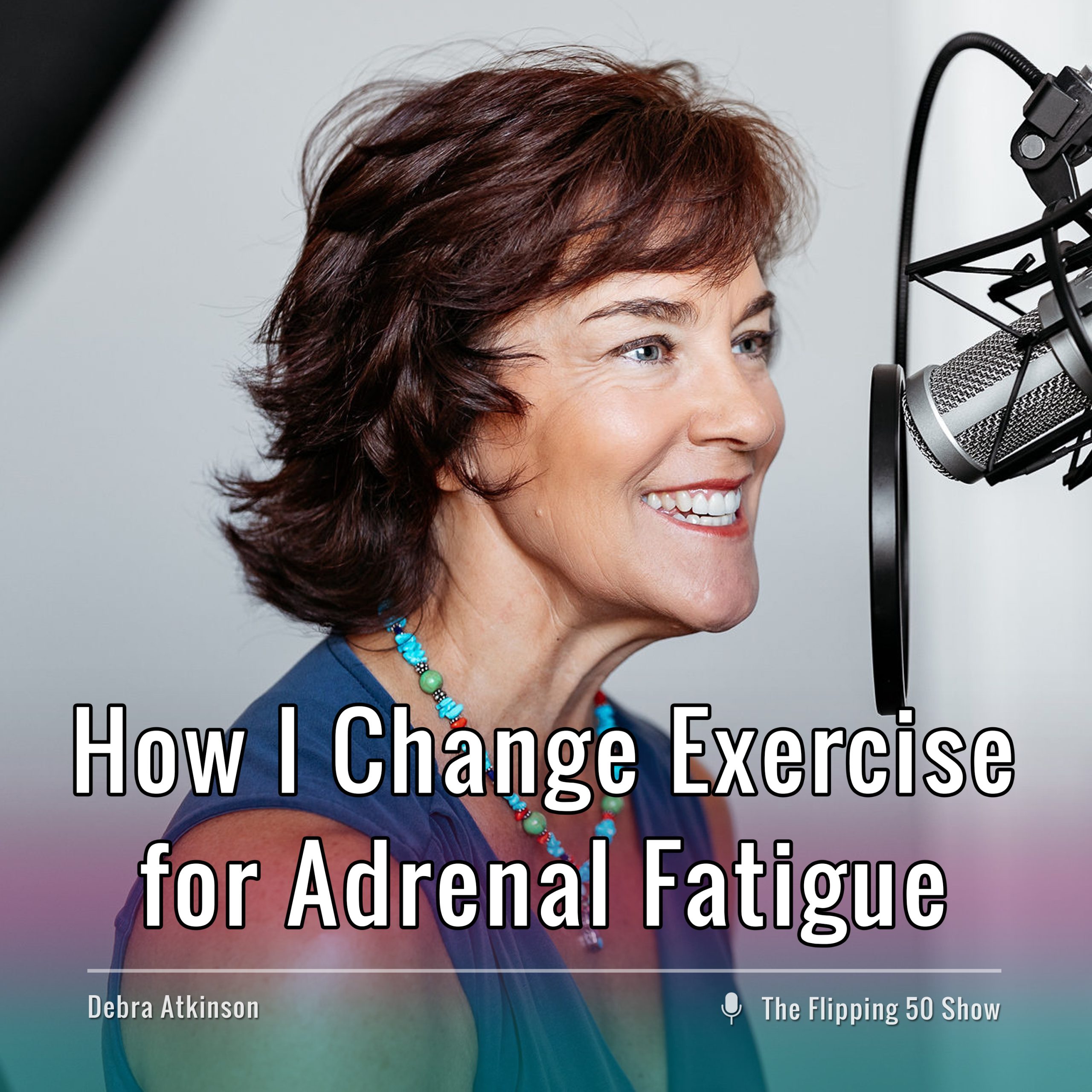
This episode of Flipping 50 The STRONGER WAY with Debra Atkinson is brought to you by Alloy Health.
- Alloy – Get your menopause treatment plan today. Visit https://myalloy.com and use code FLIPPING50 for $20 off your first order! #AgeGracefully
If you’ve attempted all the fat burning, weight loss tricks while struggling with energy due to cortisol issues, it’s time to change exercise for adrenal fatigue.
Otherwise known as adrenal insufficiency, this is a sign your exercise plan no longer matches what your body needs.
Recognize the warning signs of adrenal fatigue, why traditional fat-burning workouts can backfire, and what to do instead to support your hormones, energy, and metabolism.
In this episode, discover practical strategies to restore your energy, stabilize blood sugar, and rebuild strength without adding more stress to your body. Learn how to change exercise for adrenal fatigue so your workouts start working with your body—not against it.
Adrenal Fatigue and Low Cortisol
- Low cortisol doesn’t simply mean you’re “less stressed.” Cortisol is also an energy hormone.
- Healthy cortisol should:
- Peak in the morning.
- Gradually decline throughout the day.
- Stay within a healthy range instead of remaining chronically low.
- Extremely low cortisol can result in:
- Poor morning energy.
- Afternoon crashes.
- Difficulty responding to physical or emotional demands.
- Saliva cortisol testing provides a snapshot of cortisol throughout the day and can help identify abnormal patterns.
- Seeing objective test results often motivates behavior changes that advice alone cannot.
Change Exercise for Adrenal Fatigue Without Losing Strength or Metabolism After 40
Signs Your Body Needs a Different Exercise Strategy
- Common signs include:
- Struggling to get going in the morning (no matter how long you’ve been in bed)
- Rely on caffeine to get you started
- Might wake okay and then crash mid morning
- Have a sluggish appetite in the morning
- Have resorted to 5-Hour Energy
- Could fall asleep at dinner time ( and prefer that to eating)
- Get a second wind if you stay up past 9 or 10
- These symptoms often suggest the body is struggling to regulate cortisol and blood sugar effectively.
Traditional Exercise Can Backfire
Long, frequent, or intense workouts may become another source of stress when recovery capacity is reduced.
Key lessons:
- Exercise is another stressor added to your body’s total stress load.
- Sessions lasting beyond approximately 45–60 minutes can elevate cortisol for longer periods in susceptible individuals.
- The body’s tolerance for exercise changes depending on:
- Emotional stress
- Career demands
- Financial pressure
- Poor sleep
- Hormonal changes
- Illness
- Perimenopause itself increases overall physiological stress, meaning previous exercise routines may suddenly stop working.
- The goal becomes reducing allostatic load—the cumulative burden of stress on the body.
How to Change Exercise for Adrenal Fatigue
Instead of pushing harder:
- Remove unnecessary exercise stress
- Temporarily pause:
- HIIT
- Long cardio sessions
- Heavy resistance training
- Extended endurance workouts
- Temporarily pause:
- Keep movement gentle
- Continue walking
- Replace long walks with shorter, more frequent walks.
- Aim for brief walks after meals to improve blood sugar regulation.
- Use sunlight exposure during morning walks when possible.
- Include mind-body exercise
- Yoga
- Gentle mobility
- Relaxing movement
- Avoid long, heated, or physically exhausting yoga sessions during recovery.
Restore Energy and Burn Fat Naturally by Changing Exercise for Adrenal Fatigue
- Recovery becomes the primary goal, viewed as productive—not a setback.
- Prioritize extra sleep.
- Go to bed when genuinely tired instead of pushing through.
- Maintain regular sleep habits whenever possible.
- If recovering from adrenal fatigue, sleeping longer may temporarily be beneficial.
- Create an environment that supports restorative sleep:
- Cool room
- Dark room
- Quiet room
- Nutrition changes that support recovery
- The nutritional focus shifts toward stabilizing blood sugar.
- Eat adequate protein
- Protein remains essential for muscle and recovery.
- Don’t fear carbohydrates
- Support serotonin production.
- Help regulate cortisol.
- Improve gut health.
- Restore energy.
- Very low-carbohydrate diets may worsen symptoms for some women experiencing adrenal fatigue.
- Hydrate effectively
- Include electrolytes rather than relying on water alone.
- Avoid prolonged fasting
- Eat consistently.
- Consider a small protein-rich bedtime snack if nighttime waking is related to blood sugar drops.Stable blood sugar supports better cortisol regulation and improved energy.
- The nutritional focus shifts toward stabilizing blood sugar.
Helpful Supplements and Lifestyle Support
- Maca
- Magnesium
- Ashwagandha
- CBD
Returning to Strength Training
Recommendations once energy begins improving:
- Short sessions (10–20 minutes).
- Three sessions per week.
- Focus on foundational movements:
- Squat or hinge
- Push
- Pull
- Add exercises and training volume slowly over several weeks.
- Judge progress by:
- Better energy
- Better recovery
- Better sleep
- Reduced soreness
If workouts reduce energy afterward, reduce the training load and progress more slowly.
Strength training becomes a tool for improving blood sugar stability rather than exhausting the body.
The Best Time to Change Exercise for Adrenal Fatigue and Recover Faster
Long-Term Recovery Strategy
- Supporting cortisol rather than constantly stimulating it.
- Stabilizing blood sugar.
- Progressively rebuilding exercise tolerance.
- Listening to recovery signals instead of ignoring them.
- Seeking medical evaluation when fatigue persists to rule out nutrient deficiencies or other underlying causes.
The long-term objective is to return to exercise stronger, healthier, and with an approach that matches the body’s current capacity rather than its past performance.
If this episode made you flip your workout routine — share it!
👉 Post to your stories, tag @Flipping50TV in Instagram and share the episode to your best friend.
👉 Meet other women, who are done with outdated fitness advice, at Flipping50 Facebook Group.
👉 Subscribe, share, and leave a review if you’re ready to flip the script on Flipping 50 The Stronger Way.
Connect with Flipping 50:
- Flipping50 Insiders Facebook Group
- Instagram – @Flipping50TV
- YouTube – @Flipping50TV
- More Episodes – Flipping 50 The Stronger Way
Other Episodes You Might Like:
- Previous Episode – Why Working Harder Stops Working After 50 (And What to Do Instead)
- Next Episode – Looking for Motivation to Exercise? Active Grandparenting is your new BFF
- More Like This:
Resources:
- Understand how sleep relates to your hormones, muscle mass and weight loss with Flipping 50 Sleep Yourself Strong.
- Get BlueSky CBD to boost your mood and motivation. Use code FLIPPING to get 20% off!
- Get BIOptimizers Masszymes Digestive Enzymes to break down food optimally. Increase your absorption of key amino acids & certain vitamins to for a better digestion & gut health. Use code FLIPPING50 to get 15% off!